The Loyalty Leak
The independent coffee economy is larger than Starbucks. It serves more communities. It produces more culture. It just hasn't had the shared infrastructure yet.

Nick Martin
CEO & Co-Founder
Jun 9, 2026
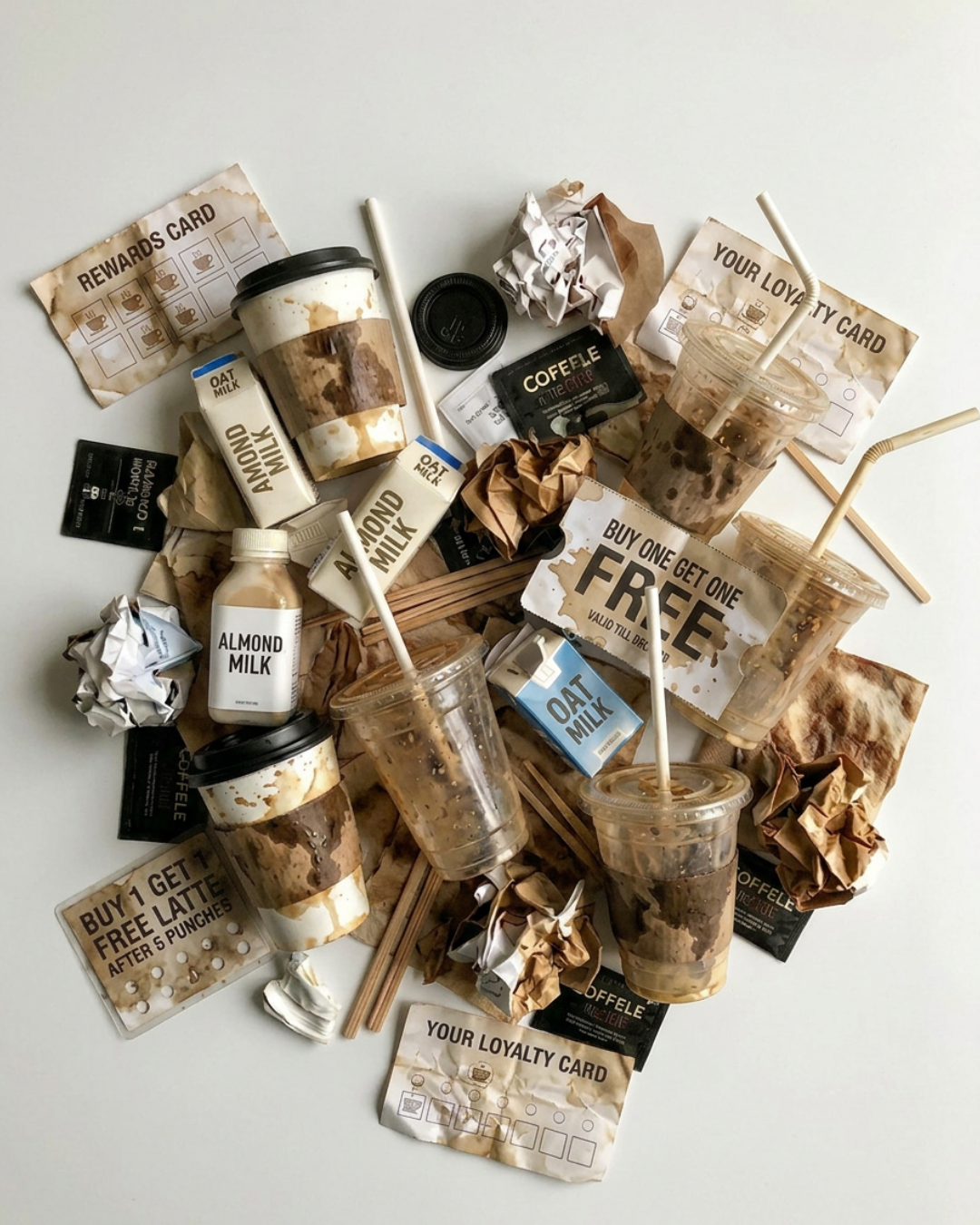
We've spent the last several years building JOE - the payments, loyalty, and data infrastructure now running across more than 1,000 independent coffee shops. In that time I've sat with a lot of operators. The conversations are often about labor, or rent, or the cost of milk. But the one I keep coming back to, because almost nobody flags it as a problem until I run the numbers in front of them, is loyalty.
Walk into almost any independent coffee shop in America and you will find the same artifact taped to the counter or buried in an app: buy nine, get one free. It's such a familiar piece of the small-business landscape that almost nobody asks what it costs.
I asked, and then I went looking for the data to confirm what the math was telling me. What I found is that the standard loyalty mechanic in independent coffee - the buy-9-or-10-get-1-free punch card and its digital descendants - gives away between ten and eighteen percent of every dollar it touches. The 2025 Independent Coffee Shop Industry Report puts the average net profit margin for an independent coffee shop at 13.8 percent. Hold those two numbers next to each other and you can see the problem in one glance: the loyalty program at most independent shops is structurally capable of consuming the entire net profit of the customers it claims to be winning.
But that's not the most important number in this piece. The most important number is what one company has built on top of a loyalty program when that program runs with real scale, real data, and real financial infrastructure behind it.
Starbucks Rewards drove $13 billion in U.S. spend in fiscal 2025 - roughly sixty percent of company-operated U.S. revenue. The Starbucks app sits on $1.8 to $1.9 billion in customer deposits at any given time, more than 85 percent of U.S. banks hold in total assets. For most of the late 2010s, the Starbucks app was the single most-used mobile payments platform in the United States - bigger than Apple Pay, bigger than Google Pay, bigger than Samsung Pay. All of this is the second-order effect of a loyalty program running at scale on infrastructure the company controls.
This piece is about both numbers. The first one - the ten-to-eighteen percent leak - is what I see across most of the independent shops we talk to before they join JOE. The second one - the Starbucks scale story - is what I think the independent coffee economy can build for itself, and what we're already several years into building.
The independent coffee economy is larger than Starbucks. It serves more communities. It produces more culture. It just hasn't had the shared infrastructure yet. That's what JOE exists to provide. This piece is the case for why it matters, what the gap costs operators today, and what closes when the infrastructure is in place.
Part One: What the loyalty program actually costs
The standard "buy nine, get one free" structure is, by design, a ten percent discount. There is no subtlety to the arithmetic. For every ten transactions a regular customer makes, the shop collects revenue on nine and gives the tenth away. Talon.One, which runs loyalty programs for coffee and quick-service brands, confirms this directly in its 2026 industry benchmark: the standard range is eight to ten purchases for a free drink, which produces roughly a ten percent reward rate.
Ten percent is the floor, not the ceiling. The number climbs once a shop adds the layers that almost every program now includes - welcome offers to drive sign-ups, double-points days to drive frequency, birthday drinks, win-back coupons for lapsed customers, seasonal promotions, and the friends-and-family taps that accumulate over time. By the time a typical loyalty program is fully running, the giveaway rate sits between fifteen and eighteen percent of loyalty-attributed sales. This is consistent with what I see across the shops we onboard - operators almost always underestimate how much they're giving back until we map it out for them.
The cleanest published data point on this comes from Paytronix, which runs loyalty for more than 1,800 restaurant and convenience brands. In its 2023 Loyalty Report, Paytronix compared the discount depth on loyalty transactions to the discount depth on non-loyalty transactions. In January 2021, the dollar discount on the average loyalty transaction was sixteen percent higher than the average non-loyalty discount. By the end of 2022, the gap had narrowed to nine percent - and Paytronix was clear that the narrowing did not happen because programs got more efficient. It happened because many restaurants had made their loyalty programs less generous in response to rising operating costs. Operators were pulling back because the spend was crushing them.
The harder finding is on what the industry calls incrementality - whether the discount actually caused the purchase, or whether the customer would have shown up and paid full price without it. Bain & Company's loyalty research found that most programs "end up with all of the cost and little benefit, paying customers extra for behavior that would occur anyway." Working examples from the loyalty analytics field typically show that a fifteen percent attributed lift translates to roughly six percent incremental lift in real customer behavior. A peer-reviewed academic study on restaurant gift cards - the closest analog to a redeemed loyalty reward - found that fifty-six percent of redeemers would have visited the restaurant anyway and did not spend more. And the 2026 CFO's Guide to Incrementality, drawing on Bain's research, reports that up to ninety-three percent of points earned by low-frequency customers go unredeemed entirely. The shop carries the liability. The behavior change never arrives.
For independent coffee, this matters more than it does for almost any other category. The 2025 Independent Coffee Shop Industry Report puts the average independent coffee shop net margin at 13.8 percent. A loyalty program giving back ten to eighteen percent of attributed sales is operating in the same percentage range as the shop's entire bottom line. The customers the program is supposed to be earning are often the customers whose visits were already locked in. The loyalty discount, in those cases, is not winning a sale. It is buying back a sale the shop already had.
But the leak is only half of the picture. The other half is what's missing.
Part Two: What Starbucks proved is possible
Starbucks runs the most successful loyalty program in the history of the coffee category, and arguably in the history of any retail category. The numbers describe a system operating at a different physical scale than what the words "loyalty program" usually conjure.
Revenue concentration. Starbucks Rewards members drove $13 billion in spend in fiscal 2025, equating to nearly sixty percent of U.S. company-operated revenue. The most recent membership figure, reported in early 2026, is 35.5 million 90-day active members in the U.S. alone, with global membership above 75 million. Loyalty member retention sits at 44 percent, nearly double the industry average of 25 percent. Members are 5.6 times more likely to visit a Starbucks daily than non-members.
Banking-scale stored value. As of mid-2024, Starbucks held approximately $1.87 billion in customer-loaded balances on its app and gift cards - money customers have prepaid that has not yet been spent. For context: 85 percent of U.S. banks have less than $1 billion in total assets. In 2016, when Starbucks held $1.2 billion in customer deposits, that figure was already larger than Customers Bank ($780 million) and Green Dot ($560 million). Customers load roughly $10 billion onto Starbucks accounts every year. The balance sitting on the company's books at any given moment functions as a no-interest loan from millions of customers, providing working capital without the cost of capital. This is one of the things I find most overlooked in the standard read of Starbucks: the company has effectively built one of the largest closed-loop deposit institutions in America without ever being chartered as a bank.
Breakage. A portion of that loaded balance is never redeemed. Some of it sits forgotten, some of it is gifted and forgotten by the recipient, some of it expires. Starbucks recognized $164.5 million in breakage revenue in 2021 and roughly $196 million in a recent fiscal year. When breakage is factored in alongside the float, Starbucks is effectively earning a negative interest rate on the deposits - being paid to hold customer money.
Mobile payments dominance. For most of the late 2010s, the Starbucks app was the single most-used mobile payments platform in the United States. In 2018, it had more in-store mobile payment users (23.4 million) than Apple Pay (22 million), Google Pay (11.1 million), or Samsung Pay (9.9 million). Apple Pay only overtook Starbucks in 2019, and even then by a narrow margin - and Apple Pay is a generic payments platform accepted at more than half of U.S. merchants. The Starbucks app is accepted at one chain. The fact that the comparison was ever close is the entire point.
Personalization and data. Starbucks runs all of this on a proprietary AI personalization engine called Deep Brew, which sends individualized offers based on each member's purchase history. Seventy-one percent of app users visit a Starbucks at least once a week. The data flywheel - every visit produces signal, every offer is tested against real behavior, every member is segmented continuously - is the deeper moat beneath the headline numbers.
The story most independent operators tell themselves about Starbucks is that none of this is achievable for them. The numbers are too big, the technology is too expensive, the scale is too far away. I want to be direct about why I think that story is partially true and dangerously incomplete. What it gets right is that no single independent shop can replicate this stack alone. What it misses is that scale, data, and financial infrastructure of this magnitude have already been demonstrated in the coffee category. The underlying playbook is now a known quantity. The question is no longer whether it works. The question is who else gets to use it.
Part Three: The asymmetry independents have been living with
Hold the two pictures from Parts One and Two next to each other.
On one side: tens of thousands of independent and small-chain coffee shops across the United States, collectively serving a community-scale, culturally significant share of the country's daily coffee, generating tens of billions of dollars a year in revenue, and each running a small loyalty program that gives back ten to eighteen percent of attributed sales while producing limited new behavior and almost no data the operator can use.
On the other side: roughly 16,000 company-operated Starbucks locations running a single shared loyalty program with 35.5 million U.S. members, $13 billion in member-driven spend, $1.9 billion in stored customer deposits, a top-tier mobile payments platform, and an AI personalization layer trained on the full firehose of member behavior.
The asymmetry is not about the quality of the coffee, the strength of the community, or the talent of the operators. The independent side wins on all three. The asymmetry is about shared infrastructure. One side has it. The other side has been told, implicitly and explicitly for two decades, that it cannot.
This is the real meaning of the loyalty leak. It is not just that independent operators are giving away ten to eighteen percent of attributed sales. It is that they are giving it away to a system that returns no data, no relationship, no float, no payments infrastructure, and no shared intelligence - while a competitor across the street is converting the same kind of customer behavior into a bank-scale balance sheet, an industry-leading payments platform, and a continuously improving personalization engine.
That gap is what closes when the independent coffee economy stops running tens of thousands of isolated loyalty programs and starts running one shared one. Which brings me to what we've been building.
Part Four: What JOE has already built
JOE is the payments, loyalty, and data layer running today across more than 1,000 independent coffee shops in the United States. It exists to give the independent operator the same kind of shared infrastructure Starbucks built for itself, with three differences that I think matter most.
The discount load is capped, not structural. JOE's loyalty program is designed to give back no more than five percent of attributed sales, replacing the ten-to-eighteen percent punch card leak with a system that has to actually pay for itself out of incremental behavior. We engineered the math the other direction from the punch card: instead of starting at a ten percent giveaway and adding from there, the program starts at a ceiling and earns the right to spend up to it through verified incremental visits. Every operator on the network keeps the eight to thirteen percentage points the punch card was quietly draining.
The infrastructure is shared. A customer who joins the loyalty program at one independent coffee shop on JOE can be recognized at any other shop on the network. This is what Starbucks gets for free when a member walks into any of 16,000 locations: continuity, recognition, and a single relationship that compounds across visits. The same continuity is now available across 1,000+ independent shops, which means an independent operator is no longer competing with the chain on customer continuity alone - they have a network behind them that produces the same effect across the category.
The relationship belongs to the operator. The customer data, the relationship history, and the upside of the relationship over time remain with the shop that introduced the customer to the system. The network amplifies what each operator can do. It does not take the customer away from them. This is the inverse of the legacy loyalty platform model, where the shop pays the cost and the platform keeps the relationship. We were unwilling to build it any other way.
The financial infrastructure layer is being built on top of this foundation. The same dynamics that turned Starbucks into a bank-scale holder of customer deposits - prepaid balances, stored value, in-app payments, working capital float - are mechanically available to any closed-loop loyalty and payments network that reaches sufficient scale. The independent coffee economy has the customer demand. What it has historically lacked is the shared rails. We are laying those rails now, one shop at a time, and the financial-infrastructure upside compounds with every shop and every customer who joins.
The mobile payments parallel is worth dwelling on for a second. The Starbucks app was, for years, the most-used mobile payments platform in America despite being usable at only one chain. The reason is mechanical: a closed-loop loyalty and payments system with concentrated daily-use behavior is one of the most powerful payments primitives that exists. Independent coffee has the same daily-use behavior, distributed across thousands of shops rather than concentrated in one brand. A shared payments layer across those shops is, in payments-platform terms, a peer of the largest closed-loop systems in the country.
That is what we are putting in place.
Part Five: What gets built with the margin that stops leaving
I want to close with what I think is the most important part of this whole picture, which is what the independent coffee economy actually does with the margin once it stops leaving.
When 1,000+ shops share a loyalty layer that costs five percent instead of fifteen, the network collectively recaptures hundreds of millions of dollars a year of margin that used to leak out as discount waste. That money does not sit in an operator's bank account untouched. It flows back into the things the independent coffee economy is actually trying to build - better wages, better sourcing, better physical spaces, better culture, more shops, more risk-taking, more weirdness, more of the things that make independent coffee what it is.
When those 1,000+ shops also share a payments rail, the network develops the same closed-loop economics that gave Starbucks its bank-scale balance sheet. Float, breakage, and lower processing costs become resources that flow back through the network to the operators, rather than being extracted by external platforms.
When the same network shares data - anonymized, governed, operator-owned - the personalization moat that took Starbucks two decades and hundreds of millions of dollars to build becomes available to the independent operator in their first month on the platform. The shop in Memphis benefits from the pattern recognition produced by the shop in Portland and the shop in Brooklyn and the shop in Tacoma. Nobody gives up their customer relationship to participate. Everybody benefits from the collective signal.
This is what shared infrastructure looks like at category scale. It does not require independents to become chains. It does not require sameness, central control, or the loss of local character. It requires only that the shared rails exist and that the value those rails produce flows back to the operators and communities they serve.
The independent coffee economy has spent twenty years competing against a single brand that figured out scale, data, and financial infrastructure for itself. The next chapter is the one where the rest of the category figures out the same playbook - together, on rails the operators own, with margin that stays in the communities that produced it.
Closing
The loyalty leak is real. The math is unforgiving. The independent coffee shop running a standard punch card or its digital equivalent is giving away ten to eighteen percent of attributed sales for behavior that mostly would have happened anyway, while a competitor across the street has converted the same kind of customer behavior into a bank-scale balance sheet and an industry-leading payments platform.
But the leak is not the end of the story. The leak is the diagnosis. The rest of the story is what we build with the margin that stops leaving - and with the shared rails that are already in place across more than 1,000 shops.
If you run a coffee shop, a roastery, or you fund this category, I'd like to talk. The infrastructure exists. The network is growing. The question is who's in.
- Nick Martin
CEO and Co-Founder, JOE
Related Joe reading
- For Coffee Shops
- Coffee Shop Loyalty Program
- POS for Coffee Shops
- Coffee Shop Marketing
- Coffee Industry Trends
- Partner Stories
- Coffee Shop POS Software
- Loyalty Marketing with Joe: Smarter Growth, Not Just Redemptions
Sources
On the loyalty leak:
- Paytronix, 2023 Loyalty Report (reporting via Restaurant Business, September 2023). The loyalty-vs-non-loyalty discount depth comparison and the narrowing gap as operators pulled back.
- Bain & Company, Turning Rewards into Loyalty. The foundational framing of the incrementality problem in rewards programs.
- 2025 Independent Coffee Shop Industry Report (Coffee Shop Keys / Coffee Shop Kickstarter). The 13.8 percent average net profit margin for an independent coffee shop.
- Talon.One, 2026 Coffee Shop Loyalty Programs Benchmark. The ~10 percent reward-rate math on standard "buy 8-10, get 1 free" punch card structures.
- Inveterate, A CFO's Guide to Incrementality in Loyalty Programs (2026). The 93 percent unredeemed-points data for low-frequency customers.
- Dreze and Nunes / restaurant gift card incrementality research (International Journal of Hospitality Management, 2017). The 56 percent finding on redeemers who would have visited anyway.
On Starbucks Rewards and the broader infrastructure picture:
- Starbucks Corporation, fiscal 2025 results and Q1 fiscal 2026 reporting. Rewards membership (35.5M active U.S.), member-driven revenue share (~60%), and $13B in member spend.
- About Starbucks press release, "Starbucks reimagines its Rewards program with new levels and exclusive perks" (January 2026). 90-day active member figures.
- Growth HQ, "Starbucks Rewards Unveiled" (December 2025). The 44% retention rate, member behavioral data, and personalization infrastructure.
- JP Koning / Moneyness, and ongoing financial press coverage of Starbucks stored value liability. The $1.6-1.9B stored value range, breakage data, and comparison to U.S. bank deposits.
- eMarketer mobile payments forecasts (multiple years, 2017-2021). The Starbucks app's position as the most-used U.S. mobile payments platform through 2018 and its top-tier position versus Apple Pay, Google Pay, and Samsung Pay in subsequent years.
- Medium / Travel Marketing Insights, "The $1.8 Billion Latte: How Starbucks Turned Loyalty Into a Banking Business" (October 2025). Synthesis of the stored-value, breakage, and float economics.
A note on the 10-18% range. Different programs sit at different points on the spectrum depending on how many promotional layers operate on top of the base reward. A shop running only the core punch-card mechanic sits near the 10 percent floor. A shop layering welcome offers, double-points days, birthday rewards, and win-back coupons on top of the base card sits near the 18 percent ceiling. The independent coffee operators on the JOE network typically describe their pre-JOE stacked programs as falling somewhere in the 12-15 percent range, consistent with the published benchmarks.
Nick Martin is the CEO and Co-Founder of JOE, the payments, loyalty, and data platform serving more than 1,000 independent coffee shops across the United States. Reach him at joe.coffee.